 Serving All Phoenix, Arizona Areas
 100% Satisfaction Guarantee

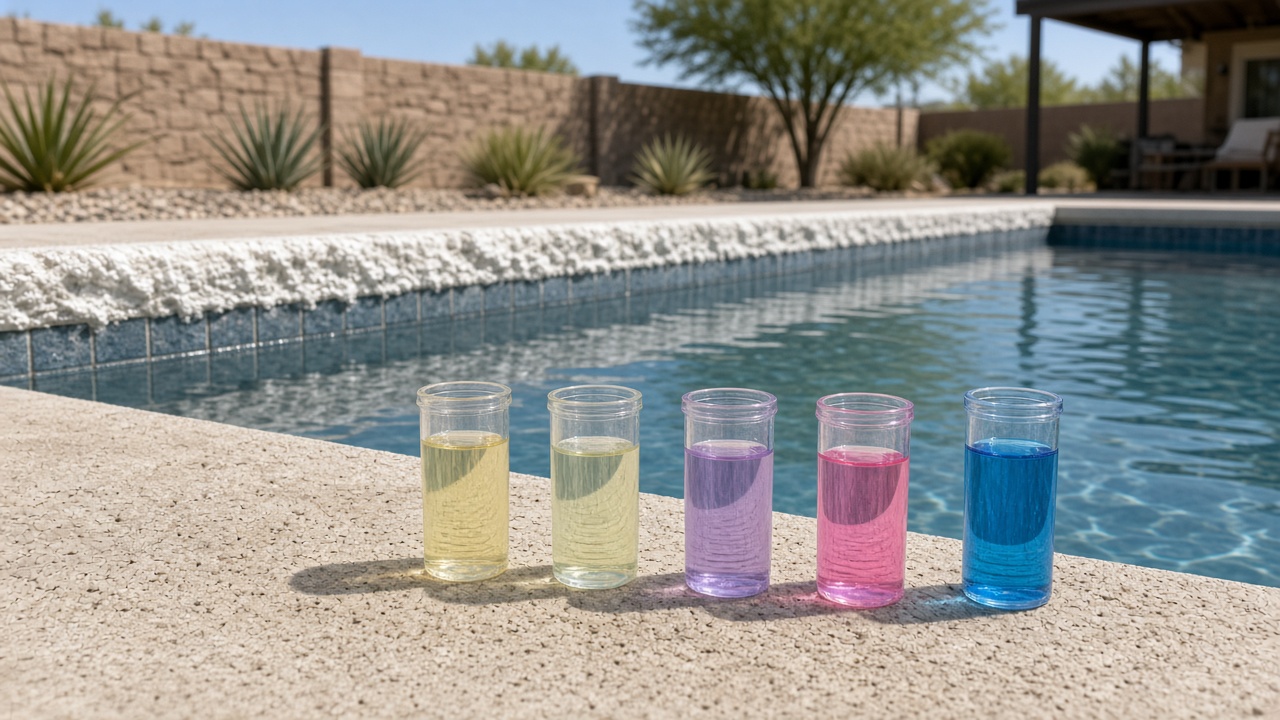
Pool chemical service in Mesa, AZ is about more than chlorine. Mesa homes get some of the hardest tap water in the Valley, and that calcium does not go away when the weather cools. What changes in fall and winter is how the water behaves with it.
At Roadrunner Pool Service, we balance Mesa pools every week of the year. This guide explains why cooler months shift the chemistry and how calcium, pH, and alkalinity fit together. For help with your pool, call 602-460-2221.
Mesa's Hard Water and Your Pool
Every time your pool tops off, new minerals come in with the water. Evaporation takes the water back out but leaves the calcium behind. Over months, hardness builds.
You see it as white crust along the tile, rough patches on plaster, and scale inside heaters and salt cells. Older plaster pools in central and west Mesa, including many in established areas like Dobson Ranch, often show years of it. Newer pools in places like Eastmark start the same process from day one.
Add dust blowing in off the Superstition Mountain corridor, and Mesa water needs steady attention. That is what our pool service in Mesa is built around.
Why Cooler Water Changes the Balance
Most people think of pool chemistry as a summer problem. In winter, chlorine does last longer, but the mineral side of the equation shifts in ways that are easy to miss.
Temperature, pH, and scaling vs. etching
Warm water tends to push calcium out of solution, which is why scale builds fast in summer. As the water cools, it generally becomes less likely to scale and can lean the other way, becoming more aggressive toward plaster and grout.
In plain terms, the same readings can act differently in January than they did in July. Balanced water sits in the middle: not depositing scale, and not pulling minerals out of your surfaces. We keep that middle ground in mind as temperatures drop instead of running a summer playbook all year.
Calcium Hardness, pH, and Alkalinity Working Together
No single number tells the whole story. These readings work as a team:
-
Calcium hardness measures how much mineral is in the water. In Mesa, the challenge is usually too much, not too little.
-
pH controls whether that calcium stays dissolved. We aim for 7.4–7.6.
-
Alkalinity acts as a buffer, keeping pH from swinging every time it rains or the pool tops off.
-
Chlorine keeps the water sanitized. We keep it in the 1–3 ppm range.
-
Cyanuric acid, or stabilizer, protects chlorine from the sun.
When pH runs high in hard water, scale forms faster. When alkalinity is low, pH bounces around and is hard to hold. Adjusting one without watching the others is how pools end up chasing problems.
Chemical-Only Service for DIY Cleaners
Some Mesa owners enjoy skimming and brushing their own pool but would rather not manage hard water chemistry. That is exactly who our chemical-only plan is for.
You keep the cleaning. We handle the testing, balancing, and treatment each week, and we empty the baskets while we are there. We see this plan work well across Mesa, from homes in retirement communities like Leisure World to busy family households that want the water right without giving up their own cleaning routine. It also suits owners who simply like staying hands-on with their pool.
If you later want us to take over the brushing and vacuuming too, our weekly pool service covers the full routine.
What We Test and Adjust Each Visit
We use professional-grade testing, not test strips. Each visit, we check chlorine, pH, alkalinity, and stabilizer, and we keep an eye on calcium hardness over time.
Then we adjust. All basic chemicals are included in the service. If your pool ever needs a specialty product, such as an algaecide, phosphate remover, or sequestrant, that may be extra, and we will tell you before we add it.
You get a detailed service slip after every visit showing your readings and what we put in the water. You can learn more on our pool chemical service page.
Mesa Pool Chemistry FAQs
Why does my tile get white crust even in winter?
The pool still evaporates on dry winter days, and the calcium stays behind at the waterline. Scale that formed in summer also does not dissolve on its own. Keeping pH and alkalinity in range slows new buildup, but existing crust usually needs to be cleaned off.
Does chemical-only service include the chemicals?
Yes. All basic chemicals are included. Specialty products may cost extra, and we always let you know first.
Do pool test strips work for Mesa's hard water?
Strips can give a rough idea, but color matching is hard to read precisely, especially for calcium and alkalinity. With water this hard, small errors add up. That is why we use professional-grade testing.
Should I raise or lower pH when the water cools?
It depends on your other readings. We keep pH within the 7.4–7.6 range and decide where in that range to hold it based on calcium, alkalinity, and water temperature. Chasing pH alone, without the rest, usually causes more swings.
Start Chemical Service in Mesa
We have been caring for East Valley pools for more than 24 years, and we know what Mesa water does to plaster and tile. We show up on the same day each week, our technicians are certified and background-checked, and we are licensed and insured.
Call 602-460-2221 or contact our team to get a free quote and start chemical service for your Mesa pool.