 Serving All Phoenix, Arizona Areas
 100% Satisfaction Guarantee

If you just bought a home with a pool, good pool service in Surprise, AZ should do more than clean the water. It should help you understand what you now own. Many Surprise homeowners have never had a pool before, and that is completely normal.
At Roadrunner Pool Service, we work with a lot of first-time owners across the West Valley. This is our first-month orientation. We cover what the equipment pad is, what we test and why, how to read our service slip, and what stays on your list between visits.
Have a question about your new pool right now? Call 602-460-2221.
Your First Month With a Pool in Surprise
The first month is about learning the basics, not becoming an expert. You need to know where things are, what normal looks like, and when to call. The rest comes with time.
Surprise is one of the fastest-growing suburbs in the West Valley, and new subdivisions keep adding pools. Whether your home is brand new or a resale along the Grand Avenue corridor, the desert treats every pool the same way. Heat, strong sun, dust, and hard water all push your water out of balance. That is why weekly pool service in Surprise matters.
A Quick Tour of Your Equipment Pad
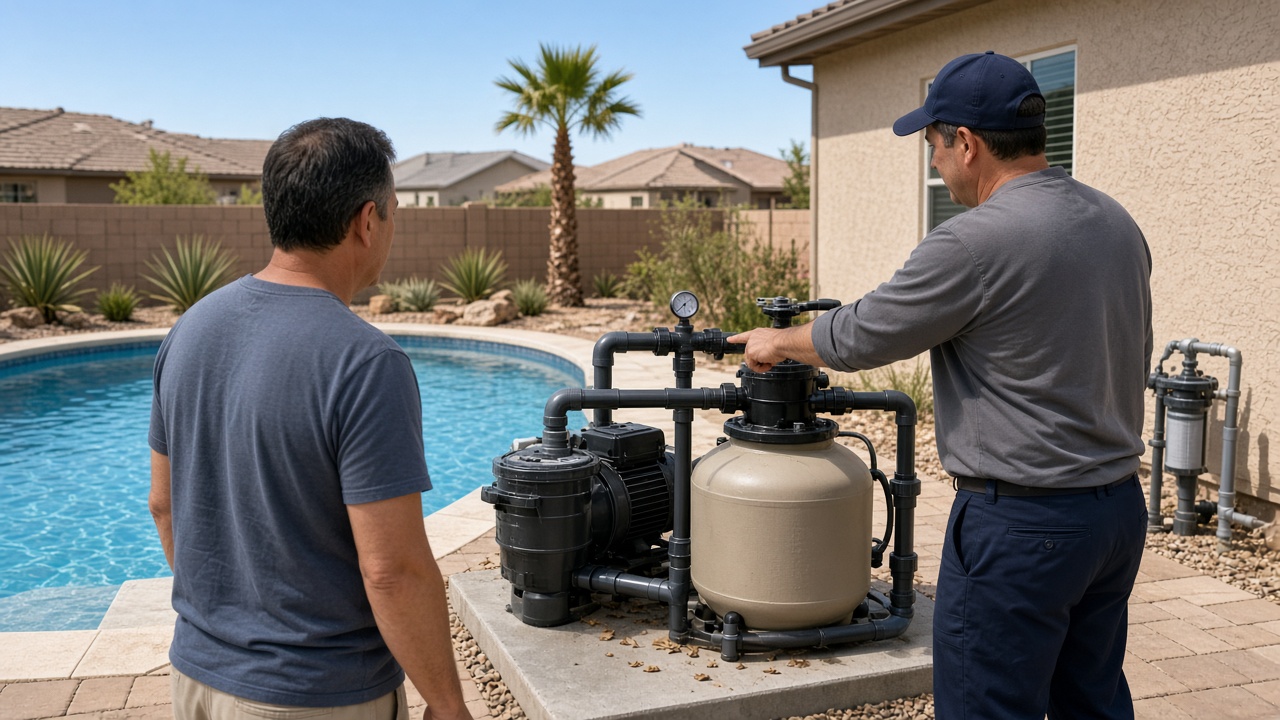
The equipment pad is the group of machines, usually along a side yard, that keeps your water moving and clean. Most pads have the same core pieces. Once you know them, the whole system makes more sense.
Pump, filter, timer or automation
-
Pump: The heart of the system. It pulls water from the pool and pushes it through everything else.
-
Filter: The tank that catches dirt and fine particles. It may be cartridge, D.E., or sand. A pressure gauge on top shows how hard it is working.
-
Timer or automation: Tells the pump when to run. Older homes may have a simple dial timer. Newer homes often have a digital panel or an app.
Some pads also have a heater or a salt system. If yours does, we will point those out on our first visit too.
Where the skimmer and returns fit in
The skimmer is the opening at the waterline with a basket inside. It pulls in leaves and floating debris before they sink. The returns are the small jets on the pool walls that send clean, filtered water back in.
Water moves in a loop: skimmer and drain, to pump, to filter, then back through the returns. When that loop slows down, water quality usually slips soon after.
Reading Your Service Slip
We leave a detailed service slip after every visit. It lists what we did, what we added to the water, and anything we noticed on the equipment. For a new owner, it is the easiest way to learn your pool week by week.
Chlorine, pH, alkalinity, stabilizer — what the numbers mean
-
Chlorine: Your main sanitizer. We aim to keep it in the 1–3 ppm range, enough to fight bacteria and algae without irritating eyes and skin.
-
pH: How acidic or basic the water is. We target 7.4–7.6. This is the number that drifts most often in Arizona pools.
-
Alkalinity: A buffer that keeps pH steady. When it is off, pH swings and is hard to hold.
-
Stabilizer (cyanuric acid): Shields chlorine from the sun. Without it, chlorine can burn off quickly on a bright day.
You do not need to memorize these. Just glance at the slip each week. If a number keeps showing up outside the range, we will explain why and what we are doing about it.
What Stays on the Homeowner's List
Weekly service covers the cleaning and the chemistry. A few simple jobs still fall to you between visits. None of them take long.
-
Watch the water level. Evaporation is fast here. Keep the water near the middle of the skimmer opening.
-
Empty the skimmer basket after a windstorm or heavy leaf drop.
-
Keep the pump powered and the timer or panel on its schedule.
-
Keep gates and access clear on your service day.
-
Tell us before you add chemicals. Store products can throw off our balance.
-
Call us if something changes, like a new noise, a wet spot near the pad, or cloudy water.
Starting Off With the Right Chemical Baseline
A strong start saves you trouble later. New pools and pools that just changed owners both benefit from a professional setting the chemical baseline early. That means a full test and a balanced starting point before small problems build.
On a new or newly purchased pool, we test chlorine, pH, alkalinity, stabilizer, and calcium hardness. We correct what is off first, then hold it steady week to week. West Valley tap water is hard, so we keep an eye on scale on the tile and equipment from day one.
Our technicians are certified and background-checked, and we have served Valley pools for more than 24 years. You can read more about our weekly pool service or our pool chemical service. Weekly maintenance plans typically start around $95–$130/month.
First-Time Owner Questions
How often should a new pool owner test the water?
With weekly service, we test on every visit, and your slip shows the results. You do not have to test on your own. If you want to learn, a simple home test between visits is fine, but please share the results with us before adding anything.
What should I do if the pool turns cloudy between visits?
First, check that the pump is running and the skimmer basket is clear. Cloudy water often points to low circulation or low chlorine. If it does not clear within a day, call us so we can check it before it turns green.
Do I need to run the pump every day in winter?
Run times usually drop in cooler months, but the pump still needs a daily schedule. We adjust it seasonally for you.
Can I start with chemical-only service and upgrade later?
In most cases, yes. Chemical-only service covers weekly testing, balancing, and basket emptying, while you handle the brushing and vacuuming. If you find you would rather hand off the cleaning too, just ask us about switching plans.
Talk to Our West Valley Team
New to pool ownership? We are happy to walk you through it. Call 602-460-2221 or our West Valley line at 623-455-3161, or contact our team for a free estimate on your Surprise pool.
```